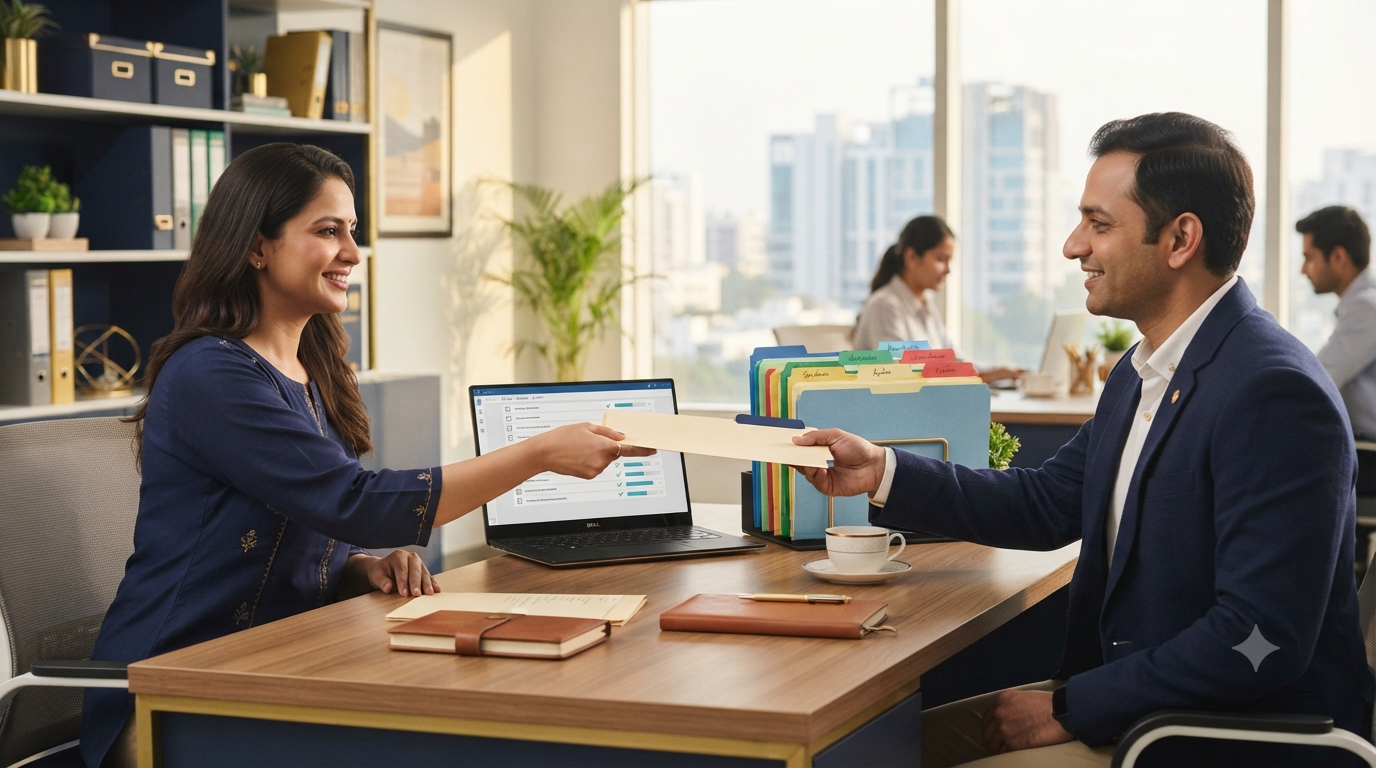
Most business loan applications do not stall because the business is weak. They stall because a document is missing, out of date, or disagrees with another one. A lender who has to chase papers loses confidence, and every week of delay is a week your business waits for the money. This checklist covers what you will typically need in Ahmedabad, by loan type, so you can get everything together once.
Get a Checklist for My Case on WhatsApp →
The Core Set: Needed for Almost Every Business Loan
- KYC of the business and the owners: PAN, Aadhaar and address proof of each promoter, director or partner.
- Constitution papers: proprietorship proof, partnership deed, or the company's incorporation certificate with MOA and AOA, plus a board resolution for companies where required.
- Udyam registration certificate, if you are a micro, small or medium enterprise. It is free to obtain, and many schemes depend on it.
- GST registration and GST returns for the last 12 months.
- Bank statements for the last 12 months from all current accounts.
- Financial statements and ITR for the last 2 to 3 years: profit and loss, balance sheet and computation of income. Newer businesses give whatever periods exist.
- Details of existing loans: sanction letters and recent statements.
Extra Documents by Loan Type
Working capital (Cash Credit or Overdraft)
- Stock statement and debtor (receivables) statement, current and consistent with your accounts
- List of major customers and suppliers
- Projected sales and cash flow for the coming year, often prepared as CMA data
- Insurance policy on stock and plant
Term loan for machinery or expansion
- Quotations or proforma invoices for the machinery or equipment
- A project report with cost, means of finance, timeline and projected cash flows (needed for larger expansions)
- Your own contribution evidence, such as bank balance or earlier payments
CGTMSE-backed loan
- Udyam registration certificate, with the activity matching what the unit actually does
- The standard set above, and a project report for new units
- The lender will confirm that it is a member lending institution and take the guarantee itself
Loan against property
- Title deed or sale deed and the chain of earlier ownership papers
- Property tax receipts and utility bills
- Approved building plan and usage permission
- No-objection certificate from the co-operative society for flats, or permission from the allotting authority for estate plots
- Details and statements of any existing loan on the property
Bank guarantee or letter of credit
- The tender document, work order, purchase order or trade contract, with the required format of the instrument
- Details of existing guarantee and LC limits
- For import or export: import-export code and past shipping documents
Where to Get Each Document
| Document | Where it usually comes from |
|---|---|
| GST returns and certificate | The GST portal, or your accountant |
| Udyam certificate | The Udyam registration portal (free) |
| Bank statements | Your bank's net banking or branch, as stamped or e-statements |
| ITR and computation | The income tax portal, or your CA |
| Financial statements | Your CA |
| Credit report | The credit bureaus, which allow you to view your own report |
| Property papers | Your records, the sub-registrar's office, the society or the allotting authority |
Check These Before You Submit
- Do the names and addresses match across PAN, GST, Udyam, bank and property papers? Small differences cause questions.
- Does GST turnover roughly match bank credits? Write a short note on any difference, such as cash sales, advances or timing.
- Are statements complete and recent, with no missing months or pages?
- Are signatures and stamps in place where required?
- Is your credit report free of errors, and are there any overdue amounts to clear first?
A Caution About Sharing Documents
Share your papers only with a lender or advisor you have verified, and take contact numbers from an official website. Never share OTPs, card details or banking passwords, and never pay a fee to "release" a loan. Legitimate lenders and advisors do not ask for these.
Want Us to Check Your File Before You Apply?
Tell us the loan you need and what you have, and SME CFO Services will tell you what is missing, what does not match, and which product fits. We are based in Navrangpura, Ahmedabad. The first consultation is free and without obligation.
Send My Details on WhatsApp Free Consultation →
📞 +91 70147 40625 (Primary) | +91 96645 00277 (Secondary)
✉️ smecfoservices@gmail.com
📍 406 Zodiac Plaza, Navrangpura, Ahmedabad 380006
Common Questions
What is the minimum set of documents for a business loan?
Generally KYC of the business and owners, constitution papers, GST returns and registration, 12 months of bank statements, and 2 to 3 years of financials and ITR. Specific loans need more.
Can I get a loan without ITR or audited accounts?
It is harder. Some lenders consider alternative evidence for small businesses, such as GST returns and bank statements, but options and terms are usually narrower. Ask the lender what it accepts.
Do I need Udyam registration?
It is needed for most MSME schemes, including CGTMSE, and it is free to obtain. Many lenders ask for it.
How old can my bank statements be?
Lenders usually want the most recent 12 months, ending close to the application date, with every account included.
What if my GST turnover and bank credits do not match?
It is common and usually explainable, for example cash sales, advances or timing differences. Reconcile 12 months side by side and prepare a short note on each difference before you apply.
Do you guarantee approval once my documents are ready?
No. Good documents help, but only the lender decides, and nobody can honestly guarantee it.
Facebook | Instagram | LinkedIn
This checklist is general guidance. Lenders may ask for additional or different documents depending on the loan and the case. SME CFO Services is an independent financial advisory firm and not a direct lender; loan sanction rests with the respective banks and NBFCs.